Recognising Strengths
 The longer I work in our bariatric clinic, the more I am convinced that this is where you will see some of the strongest people alive. Certainly, no one can begin to imagine what it takes to live as a large person in a fat-phobic society, where carrying excess weight is constantly linked to failure, not to mention ridicule, shame, and blame.
Add to this, the trials and tribulations that many of my patients have faced (some of which are often directly linked to their weight gain), I often wonder just how much effort it takes to go on day after day, never mind showing up in our clinic.
It is therefore absolutely no surprise to me, that our interviews with patients and providers, published in Clinical Obesity, identified the importance of reminding our patients on just how strong they really are.
“Patients attributed great importance to the process of recognizing their own strength. Data bears witness to the powerful impact internalized stigma had on peoples’view of self and their ability to be healthy. By listening for examples of resiliency in patients’ past and labelling them as strengths, providers fostered a shift in participants’view of themselves, which improved their confidence in implementing changes.Patients noticed this as an unexpected impact of a conversation about obesity. Many shared that they had expectedadvice on diet and exercise, behaviours they felt they were failing at. Instead, recognizing strengths opened up a space of potential for identifying strategies that people could succeed at, enjoy and find meaningful for their life. This strength-based approach positively impacted participants’ confidence, self-worth and hope.”
Indeed, it is not hard to identify strengths in any patient. In fact, I often find myself listening to my patients and silently wondering how they have managed to not be twice their size, given what they have been through.
Most patients have heroically mastered other aspect of their lives (e.g. raising four kids as a single parent, surviving an abusive marriage, coming clean from a long-history of substance abuse, etc., etc.). Many have excelled in their professions or serve as important pillars of their communities.
Only when it comes to controlling their body weight, they perceive themselves as “failures”. Usually, this perception of failure is based on a flawed understanding of the real biological challenges that patients face in trying to manage their weight.
Clearly, identifying and building on inherent strengths, is a far more promising strategy than shame and blame, which we know does the exact opposite of what we are trying to help patients achieve.
@DrSharma
Edmonton, AB
Time To Change The Obesity Narrative
 This week, I once again presented on the need for recognising obesity as a chronic disease at the annual European Society for the Study of Obesity Collaborating Centres for Obesity (EASO-COMs) in Leipzig, Germany.
Coincidently, The Lancet this week also published a commentary (of which I am a co-author) on the urgent need to change the obesity “narrative”.
So far, the prevailing obesity “narrative” is that this is a condition largely caused by people’s lifestyle “choices” primarily pertaining to eating too much and not moving enough, and that this condition can therefore be prevented and reversed simply by getting people to make better choices, or in other words, eating less and moving more.
As pointed out in the commentary, this “narrative” flies in the face of the overwhelming evidence that obesity is a rather complex multi-factorial heterogenous disorder, where long-term success of individual or population-based “lifestyle” interventions can be characterised as rather modest (and that is being rather generous).
This is not to say that public health measures targeting food intake and activity are not important – but these measures go well beyond “personal responsibility”
” The established narrative on obesity relies on a simplistic causal model with language that generally places blame on individuals who bear sole responsibility for their obesity. This approach disregards the complex interplay between factors not within individuals’ control (eg, epigenetic, biological, psychosocial) and powerful wider environmental factors and activity by industry (eg, food availability and price, the built environment, manufacturers’ marketing, policies, culture) that underpin obesity. A siloed focus on individual responsibility leads to a failure to address these wider factors for which government policy can and should take a leading role. Potential health-systems solutions are also held back by insufficient understanding of obesity as a chronic disease and of the necessary integration across specialties.“
It is also important to recognise that the prevailing “lifestyle” narrative plays a major role in the issue of weight-bias and discrimination:
“Behind every obesity statistic are real people living with obesity. The prevailing narrative wrongly portrays people with obesity in negative terms as “guilty” of obesity through “weakness” and “lack of willpower”, succumbing to the siren call of fast and other poor food choices. This narrative leads to stigmatisation, discrimination—including in health services, employment, and education—and undermines individual agency.“
Thus, it is time to change this narrative:
“If the narrative is instead reframed around individuals at risk of or living with obesity as protagonists with agency who operate within physiological limitations and a much larger obesogenic environment over which their control is limited, then a better, more accurate story can be told.“
This new narrative must incorporate four dimensions.
“First, recognise that obesity requires multiple discrete actors and sectors to work together simultaneously through many entry points. Second, change the words and images used to portray obesity to shift blame away from individuals and towards upstream drivers. For example, photographs of anonymous or faceless people with obesity must be substituted with images of real people that foster respect and identification. Third, prioritise childhood obesity and the growing burden of obesity in low-income settings. Rights-based policy approaches that address inequalities and social and physical determinants of obesity are particularly relevant. Finally, appreciate that obesity is a chronic disease within the health system, with both its prevention and management embedded within calls for effective and comprehensive universal health coverage globally.“
Following this line of reasoning we argue that,
“Shifting to a human-focused narrative that encompasses this vulnerability and complexity will require effort and commitment across many sectors. We call on all affected by or concerned with obesity to come together with a common sense of purpose and shared accountability for building this new narrative and a more comprehensive response to obesity.“
Not discussed in this paper (largely due to space limitation), is my pet peeve, that we also need a new non-anthropometric definition of obesity – one that relies on actual health measures rather than just scales and measuring tapes. As we move to a “disease” definition of obesity, we need to ensure that we are not mis-labeling healthy individuals as “diseased” just because they happen to exceed a certain body weight, as well as the corollary, mis-labeling individuals who may stand to benefit from obesity treatments as not having obesity just because they fall below an arbitrary BMI cutoff.
@DrSharma
Leipzig, Germany
World Health Organisation Warns About The Health Consequences Of Obesity Stigma
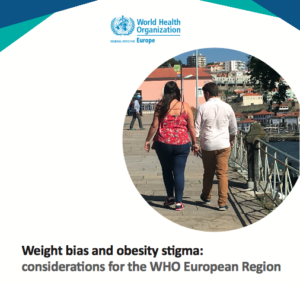
Yesterday (World Obesity Day), the European Regional Office of the World Health Organisation released a brief on the importance of weight bias and obesity stigma on the health of individuals living with this condition.
The brief particularly emphasises the detrimental effects of obesity stigma on children:
“Research shows that 47% of girls and 34% of boys with overweight report being victimized by family members. When children and young people are bullied or victimized because of their weight by peers, family and friends, it can trigger feelings of shame and lead to depression, low self-esteem, poor body image and even suicide. Shame and depression can lead children to avoid exercising or eatng in public for fear of public humiliation. Children and young people with obesity can experience teasing, verbal threats and physical assaults (for instance, being spat on, having property stolen or damaged, or being humiliated in public). They can also experience social isolation by being excluded from school and social activities or being ignored by classmates.
Weight-biased attitudes on the part of teachers can lead them to form lower expectations of students, which can lead to lower educa onal outcomes for children and young people with obesity. This, in turn, can affect children’s life chances and opportunities, and ultimately lead to social and health inequities. It is important to be aware of our own weight-biased attitudes and cautious when talking to children and young people about their weight. Parents can also advocate for their children with teachers and principals by expressing concerns and promo ng awareness of weight bias in schools. Policies are needed to prevent weight-victimization in schools.”
The WHO Brief has important messages for anyone working in public health promotion and policy:
Take a life-course approach and empower people:
Monitor and respond to the impact of weight-based bullying among children and young people (e.g. through an -bullying programmes and training for educa on professionals).
• Assess some of the unintended consequences of current health-promo on strategies on the lives and experiences of people with obesity. For example:
- Do programmes and services simplify obesity?
- Do programmes and services use stigmatizing language?
- Is there an opportunity to promote body positivity/confidence in children and young people in health promotion while also promoting healthier diets and physical activity?• Give a voice to children and young people with obesity and work with families to create family-centred school health approaches that strengthen children’s resilience and consider positive outcomes including but not limited to weight.• Create new standards for the portrayal of individuals with obesity in the media and shift from use of imagery and language that depict people living with obesity in a negative light. Consider the following:
- avoiding photographs that place unnecessary emphasis on excess weight or that isolate an individual’s body parts (e.g. images that dispropor onately show abdomen or lower body; images that show bare midri to emphasize excess weight);
- avoiding pictures that show individuals from the neck down (or with face blocked) for anonymity (e.g. images that show individuals with their head cut out of the image);
- avoiding photographs that perpetuate a stereotype (e.g. ea ng junk food, engaging in sedentary behaviour) and do not share context with the accompanying wri en content.
Strengthen people-centred health systems and public health:
• Adopt people-first language in health systems and public health care services, such as a “patient or person with obesity” rather than “obese patient”.
• Engage people with obesity in the development of public health and primary health care programmes and services.
• Address weight bias in primary health care services and develop health care models that support the needs of people with obesity.
• Apply integrated chronic care frameworks to improve pa ent experience and outcomes in preventing and managing obesity. In addition:
- recognize that many patients with obesity have tried to lose weight repeatedly;
- consider that patients may have had negative experiences with health professionals, and approach patients with sensitivity and empathy;
- emphasize the importance of realistic and sustainable behaviour change – focus on meaningful health gains and
- explore all possible causes of a presenting problem, and avoid assuming it is a result of an individual’s weight status.
- Acknowledge the dificulty of achieving sustainable and significant weight loss.
Create supportive communities and healthy environments:
- Consider the unintended consequences of simplistic obesity narratives and address all the factors (social, environmental) that drive obesity.
- Promote mental health resilience and body positivity among children, young people and adults with obesity.
- sensitize health professionals, educators and policy makers to the impact of weight bias and obesity stigma on health and well-being.
Hopefully, these recommendations will find their way into the work of everyone working in health promotion and clinical practice.
The whole brief is available here.
@DrSharma
Edmonton, AB
World Obesity Federation Recognises Obesity As a Chronic Relapsing Progressive Disease
 Following in the footsteps of other organisations like the American and Canadian Medical Associations, the Obesity Society, the Obesity Medical Association, and the Canadian Obesity Network, this month, the World Obesity Federation put out an official position statement on recognising obesity as a chronic relapsing progressive disease.
The position statement, published in Obesity Reviews, outlines the rationale for recognising obesity as a chronic disease and is very much in line with the thinking of the other organisations that have long supported this notion.
In an accompanying commentary, Tim Lobstein, the Director of Policy at the World Obesity Federation notes, that recognising obesity as a disease can have the following important benefits for people living with this disease:
1) A medical diagnosis can act to help people to cope with their weight concerns by reducing their internalized stigma or the belief that their problems are self-inflicted and shameful.
2) A classification of obesity as a disease, or disease process, may help to change both the public and professional discourse about blame for the condition, the latter hopefully encouraging greater empathy with patients and raising the patient’s expectations of unbiased care.
3) Recognition of obesity as a disease may have benefits in countries where health service costs are funded from insurance schemes that limit payments for non-disease conditions or risk factors.
While all of this is great, and I am truly delighted to see the World Obesity Federation come around to this statement, I do feel that the policy statement seems rather tightly locked into the notion that obesity (or at least most of it) is a disease “caused” primarily by eating too much, with the blame placed squarely on the “toxic obesogenic environment”.
Personally, I would rather see obesity as a far more etiologically heterogenous condition, where a wide range of mental, biological and societal factors (e.g. genetics, epigenetics, stress, trauma, lack of sleep, chronic pain, medications, to name a few) can promote weight gain in a given individual.
Although these factors may well operate through an overall increase in caloric consumption (or rather, a net increase in energy balance), they, and not the act of overeating per se must be seen as the underlying “root causes” of obesity.
Thus, I tend to see “overeating” (even if promoted by an obesogenic food environment) as a symptom of the underlying drivers rather than the “root cause”.
Thus, saying that obesity is primarily caused by “overeating” is perhaps similar to saying that depression is primarily caused by “unhappiness”. Readers would probably agree that such a statement regarding the etiology of depression would make little sense, as “unhappiness” is perhaps a symptom but hardly the “cause” of depression, which can be promoted by a wide range of biological, environmental and societal factors, all resulting in the underlying biology that results in the mood disorder.
Similarly, I would say that there are indeed a number of complex socio-psycho-biological factors that underly the biology that ultimately results in overeating and excess weight gain (the food environment clearly being one of these factors).
While this may seem like semantics, I do think that a more differentiated look at the underlying etiology of obesity at the individual level (rather than simply blaming it all on “overeating”), is essential for promoting a more sophisticated view of this complex chronic disease both at the level of the individual and the population.
@DrSharma
Edmonton, AB
Patients’ Voices at the European Congress on Obesity
 Attendees at the recent 5th Canadian Obesity Summit, hosted by the Canadian Obesity Network, will hardly have missed the important role that patient champions played at this meeting.
Thus, for e.g. every plenary session was opened by a brief presentation from a representative of the Canadian Obesity Network’s Public Engagement Committee, which not only illustrated the remarkable diversity of individual “obesity stories” but also set the stage for the scientific and clinical presentations that followed.
Indeed, one of the recurring themes at the Canadian Obesity Summit was, “nothing about us, without us”.
Thus, I was happy to see that the “patient voice” is also gaining increasing attention at the European Congress on Obesity, currently taking place in Porto, Portugal.
In fact, the conference was kicked off by a workshop on weight bias, discrimination, and other issues relevant to people living with obesity, organised by representatives of the EASO patient council, with representatives from across Europe.
How much impact these presentations and role of people living with obesity will have on the overall conference will remain to be seen, but clearly, as in other areas of medicine, the patient voice is certainly become more important as a driver of knowledge and policy – as it should.
@DrSharma
Porto, Portugal
Watch Dr. Sharma in the News!
Listen to Dr. Sharma!