The M & Ms of Obesity Assessment
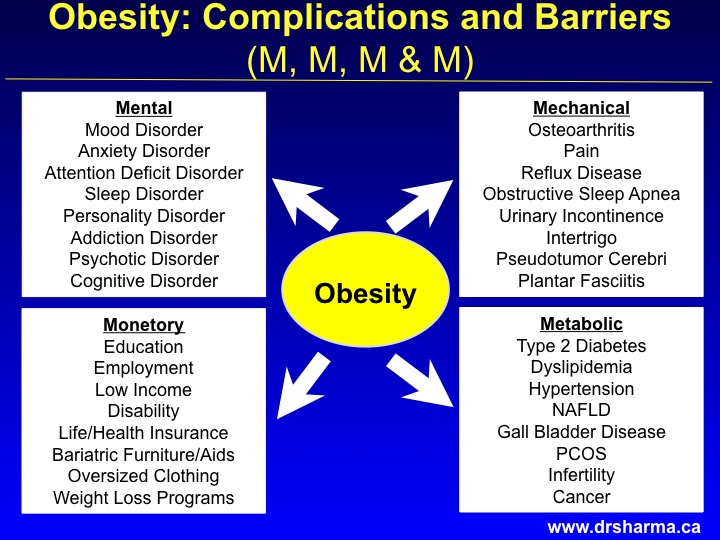 Most textbooks on obesity will tell you that assessing someone for obesity should start with a careful exploration of weight history, eating habits and lifestyle.
I disagree!
For reasons that I will outline below, I believe that the proper assessment of patients presenting with excess weight should first focus on the four “M”s or the mnemonic “M”, “M”, “M”, & “M”.
As I presented yesterday in a talk on obesity assessment at the American Heart Association Meeting in Orlando, obesity is not only a remarkably heterogeneous condition resulting from a wide range of environmental, psychosocial and biomedical causes, successful weight management is also remarkably difficult and tenuous even in the most motivated and determined of patients.
The primary goal of assessment therefore should first strive to identify the possible causes and circumstances leading to excess weight gain, determine to what extent that excess weight is affecting health and systematically look for barriers that will make weight management difficult, if not impossible.
Each of the four “M”s explores a domain that is potentially relevant to all of the above questions.
The first “M” stands for “Mental Health”. Not only can common mental health problems often lead to weight gain (e.g. depression, addictions, attention deficit, abuse, PTSD, sleep disorders, emotional eating, etc.), but when present (as is often the case), they can make weight management most challenging. In addition, excess weight can directly affect mental health by promoting poor self-esteem, depression and social anxiety disorder. Thus, devising a weight management plan always requires a good understanding of a patient’s mental health status, if only to determine that there are indeed no major mental health causes or consequences of weight gain nor significant mental health barriers that will make weight management difficult, if not impossible.
The second “M” is a reminder to look for the many “Mechanical” causes or complications of excess weight. These can present in the form of back pain or osteoarthritis, sleep apnea, reflux disease, urinary incontinence, and many other problems associated with excess weight. When present, these issues can not only promote or exacerbate weight gain but can also pose important barriers to weight management – clearly someone with plantar fasciitis is unlikely to walk the recommended 10,000 steps.
The third “M” should prompt us to look for the wide range of “Metabolic” complications of excess weight. These not only include diabetes, dyslipidemia or gout, but also hypertension (a problem of sodium metabolism), fatty liver and gall-bladder disease, polycystic ovary syndrome, and some forms of cancer. Often the presence of these conditions or the treatments we use to control them can contribute to further weight gain rather than help solve the problem.
The fourth “M” stands for “Money”, a not unimportant factor that can affect weight gain (healthy eating is expensive) or pose an important barrier to weight management (weight management costs time and money).
Only after a complete understanding of the four “M”s can a clinician hope to fully appreciate the likely causes and consequences of obesity and the potential barriers to its treatment in a given patient.
Only after we have fully explored the four “M”s does it make sense to delve further into issues related to energy balance, i.e. ingestive behaviour, energy metabolism and physical activity in order to devise a sensible and effective management plan.
As I have argued before, simply assessing and describing a behaviour is not a diagnosis – understanding the root cause of that behaviour is.
AMS
Toronto, Ontario
Watch Dr. Sharma in the News!

Listen to Dr. Sharma!