Do Obese People With Heart Disease Benefit Less From Cardiac Rehab?
 Few events are likely to command your attention as urgently as a sudden interruption of blood flow to your heart muscle.
Fortunately, thanks to the miracle of modern cardiac revascularization, you may well find yourself amongst the many, who today survive this “heart-wrenching” event – a situation which often precipitates remarkably intense longings for lifestyle change.
Indeed, at no time (other than January 1), would you meet anyone more determined to swear off their cigarettes, convert to the solemn teachings of Canada’s Food Guide and embrace the rejuvenating powers of exercise – an only fitting response to celebrate this new lease on life.
This is why many modern health systems dedicate a significant amount of personnel and resources to the exploitation of this life-changing moment with the laudable goal of “re-habilitating” the fortunate survivor to a life of healthier habits.
But, you may ask, is even such a dramatic event enough to prompt lasting betterment in the victims? And, will those, who have brought this upon themselves through their supposedly unholy practice of gluttony and sloth, really manage to turn things around?
This burning question has now been thoroughly examined by Billie-Jean Martin (a former Obesity Network Bootcamper) and colleagues from the University of Calgary, in a paper published in OBESITY.
Happily enough, almost 4,000 participants, studied one year after their participation in a 12-week rehabilitation program (which invoked the dedicated services of exercise physiologists, nurses, registered dieticians, social workers and clinical psychologists), did indeed experience a small but measurable improvement in aerobic fitness – a parameter known to forecast survival.
Sadly, however, not everyone benefitted equally. Despite enthusiastic participation in the program, obese patients (who also happened to start off on a poorer footing in terms of exercise capacity) showed a lesser sustained improvement in peak estimated metabolic equivalents (a sciency measure of aerobic fitness) than their less corpulent counterparts.
Prejudiced readers should, however, not jump to the conclusion that the obese participants were perhaps less enthusiastic or committed to this enterprise.
Indeed, during the 12 week intervention, the obese group increased their weekly mins at the prescribed exercise heart rate by 40 mins (from 123 to 163), whereas their leaner peers merely managed to add a measly 10 mins to their routine (from 153 to 164). Clearly, the obese participants were not shying away from the extra effort – if anything, they were working substantially harder (relatively speaking) than their leaner colleagues.
Notably, at one year, BOTH groups had regressed in their enthusiasm to slightly BELOW their baseline weekly mins of exercise heart rates; the obese group fell back to 121 mins, while the normal weight group fell back to 150 mins.
Thus, to be fair, NEITHER group managed to sustain the recommended 160+ mins of weekly exercise heart rate at 12 months.
It would seem that neither the “life-changing” occurrence of clogged coronaries nor 12 weeks of the dedicated services of an inter-disciplinary team of healthcare professionals, appears to be all that life-changing after all.
Would a 16 week program, a 24 week program, or perhaps even a 52 week program have lead to better results?
My gut tells me that any “time-limited” behavioural-change program will always produce “time-limited” behavioural change.
Apparently, the situation for cardiac rehab appears no better than the story for weight loss – when “treatment” stops, the lifestyle/weight comes back.
Incidentally, the Albertan actors in this story are no better or worse than the rest of Canada.
According to a recent report from Statistics Canada, three in four smokers with respiratory disease do not quit smoking; most people with diabetes or heart disease will not become more physically active and virtually no one diagnosed with cancer, heart disease, diabetes or stroke will increase their intake of fruit and vegetables.
Nonetheless, I am told, cardiac rehab efforts have demonstrated benefits in a host of modifiable cardiovascular risk factors, at least during and perhaps for a few months following the intervention.
However, the durability of these efforts certainly leave substantial room for improvement across the full spectrum of body shapes and sizes.
AMS
Edmonton, AB
 Martin BJ, Aggarwal SG, Stone JA, Hauer T, Austford LD, Knudtson M, & Arena R (2012). Obesity negatively impacts aerobic capacity improvements both acutely and 1-year following cardiac rehabilitation. Obesity (Silver Spring, Md.), 20 (12), 2377-83 PMID: 22627915
.
Edmonton Obesity Stage in Italian Workers
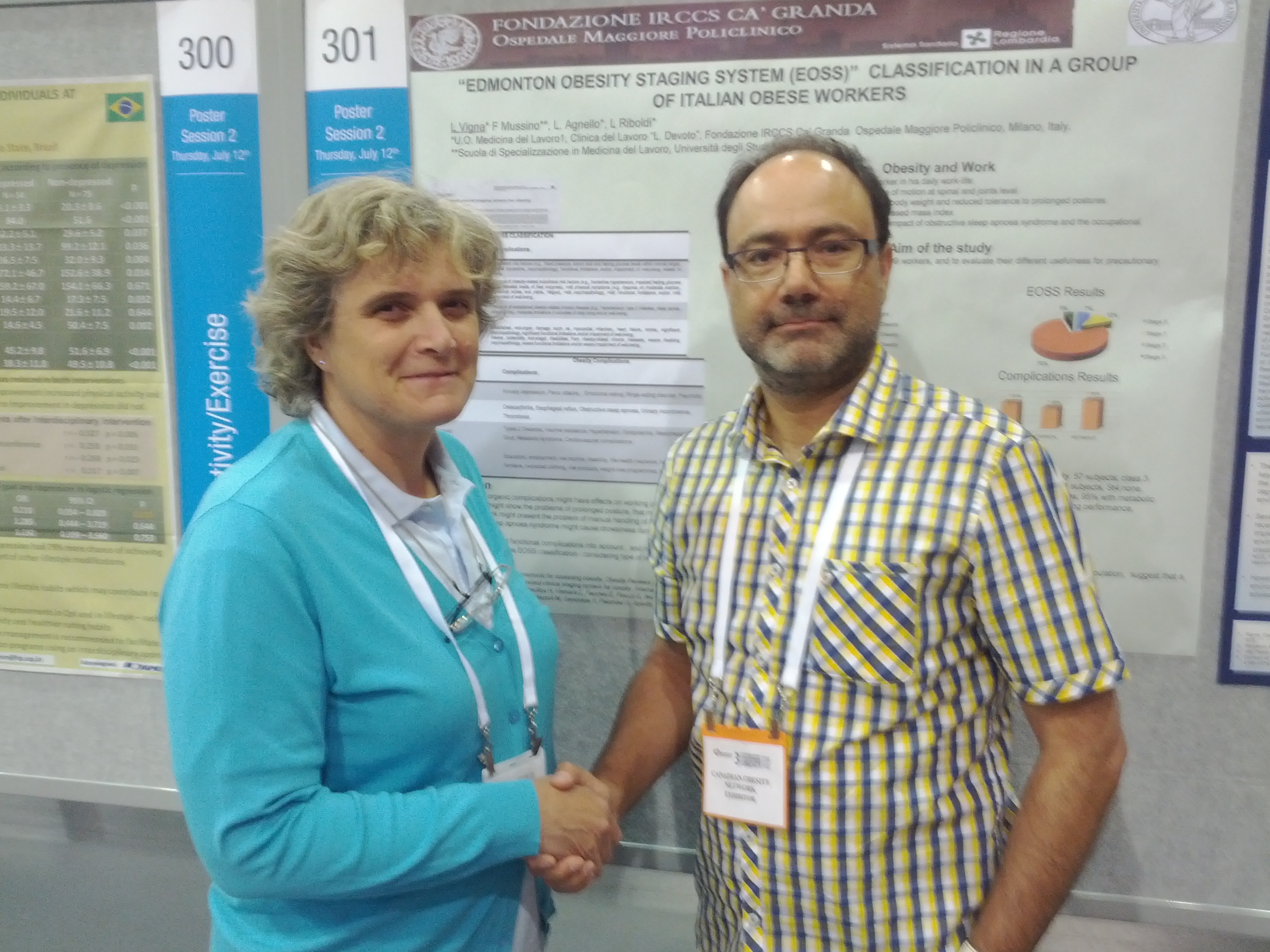
Luisella Vigna and Arya Sharma
Amongst the many posters being presented at the 3rd International Congress on Abdominal Obesity this week, one that (for obvious reasons) caught my attention is a study by Vigna and colleagues from the Occupational Medicine Unit, Fondazione IRCCS Ca’ Granda Ospedale Maggiore Policlinico, University of Milan, which looked at the Edmonton Obesity Staging System (EOSS) in a group of 134 overweight and obese workers (BMI greater than 25).
Surprisingly, the vast majority of participants (76%) had Stage 2 obesity, with only 7% and 9% having Stage 0 and 1, respectively.
This relatively high burden of comorbidities and complications was reflected in the fact that 81% had mental health problems, 66% had ‘mechanical’ complications, and well over 90% had metabolic risk factors or comorbidities.
Over 38% of participants reported a direct impact of their personal health on their work performance.
Given that there was a rather poor relationship between BMI levels and the actual presence or impact of comorbidities, the authors conclude that assessment of obesity stage rather than simply BMI may give a better idea of the ‘occupational’ health of individuals with excess weight, particularly in the assessment for specific professional activities for which mental, mechanical or metabolic health may be of particular importance rather than just a measure of size.
AMS
Québec City, QC
Impact of Severe Obesity on Post-Acute Rehabilitation Costs

Glenrose Rehabilitation Hospital, Edmonton, AB
Some of the greatest advances in modern medicine are in the field of rehabilitation – from accident victims to individuals with strokes and heart attacks, diligently working with patients to restore their health and function can be time consuming, resource intensive, but also immensely rewarding to patients, their families, and society.
Unfortunately, when patients are also severely obese, costs and duration of rehabilitation dramatically increase. Thus, in a paper we recently published in the Journal of Obesity, we looked at the impact of severe obesity on post-acute rehabilitation efficiency, length of stay, and hospital costs.
We retrospectively looked at these parameters in 42 severely obese subjects (mean age 53 y; mean BMI 50.9) and compared them to 42 nonobese controls (mean age 59 y; mean BMI 23.0) matched by sex and admitting diagnosis.
Although in the end the severely obese subjects achieved the same functional independence measure as the lean controls (0.58 vs. 0.67), they experienced longer total length-of-stay (98.4 vs. 37.4 days), rehabilitation length-of-stay (55.8 vs. 37.4 days), and waiting for transfer (42.6 vs. 0 days).
This resulted in almost a three-fold increase in hospital costs ($115,822 vs. $43,969).
It is apparent from these findings that the most significant determinant of higher costs in severely obese rehab patients is not the cost for their treatment but their considerably longer length-of-stay after achieving their rehabilitation goals.
As discussed in our paper,
“We suspect that the increased waiting-for-transfer-of-service length-of-stay in the severely obese is a consequence of the patient’s inability to gain independence following rehabilitation. In our experience, these subjects cannot return home and due to a lack of suitable alternative discharge destinations, often wait in hospital for transfer to a nursing home.”
This speaks to the lack of appropriate bariatric care facilities in nursing homes and the difficulties that severely obese patients may often face in their usual home and familial settings with even modest additional limitations that remain after the completion of in-patient rehabilitation. Indeed, few homes and personnel delivering home care are equipped or trained to deal with the special needs to individuals with severe obesity.
We also discuss at length some of the considerable challenges that severely obese patients face whilst within the rehabilitation setting:
“However there are very limited published data on bariatric-specific PAR interventions and this deficiency was recently recognized at a multidisciplinary consensus conference [hosted by the Canadian Obesity Network]. Many potential barriers to developing effective rehabilitation strategies in bariatric patients were identified by this expert panel, including the lack of bariatric-specific rehabilitation programs in both acute and post-acute rehabilitation, a paucity of standards of care specific to obese patients, weight bias on the part of health care staff, and a lack of training programs and research consortia specializing in bariatric rehabilitation. The higher prevalence of medical complexity, mental health impairment, and psychosocial dysfunction in the severely obese were also recognized as potential barriers to effective rehabilitation and factors that may increase the likelihood of acute illness relapse during post-actue rehabilitation.”
Despite these limitations, it is clear that much of the excess cost is simply due to increased length-of-stay of patients waiting for transfer either back home or to a long-term care facility. While it is important to consider the “bed blocking” effect (preventing use of these beds for other patients requiring rehabilitation) and to reductions in cost-efficient health care delivery, it is as important to recognize the need for creating structures and resources that will better allow these patients to be reintegrated into the community – at home or in a long-term care facility.
We should remain conscious of how weight bias may play a role in our reluctancy to adequately meet these challenges of this special population.
AMS
Leipzig, Germany
Padwal RS, Wang X, Sharma AM, & Dyer D (2012). The impact of severe obesity on post-acute rehabilitation efficiency, length of stay, and hospital costs. Journal of obesity, 2012 PMID: 22523669
.
Proposed Functional Scoring in the Edmonton Obesity Staging System
 As regular readers may be well aware, the Edmonton Obesity Staging System (EOSS), now validated against several large prospective datasets including NHANES III, NHANES (1999–2004), and the Cooper Clinic Longitudinal Study, is a far better indicator of mortality risk in overweight and obese individuals than BMI, waist circumference, or even metabolic syndrome.
While determining EOSS stages for medical conditions such as hypertension, diabetes, or dyslipidemia is relatively straightforward and can be based on (more or less) accepted definitions within these conditions, scoring of physical function may be more complicated.
In our original proposal, we had recommended that functional limitations could be scored by the provider using clinical judgement as being either absent (Stage 0), mild (Stage 1), moderate (Stage 2), severe (Stage 3), or disabling/endstage (Stage 4).
However, I understand that for research (and perhaps even in clinical settings), one may wish to simplify and be more specific about what exactly entails ‘mild’, ‘moderate’, or ‘severe’.
In this context, I was quite intrigued by the findings of the impact of weight management on mobility in individuals with type 2 diabetes in the LookAHEAD study recently published in the New England Journal of Medicine.
Here is how the authors describe the assessment of mobility in that paper:
“Mobility was assessed on the basis of 6 of 11 items on the Medical Outcomes Study 36-Item Short-Form Health Survey (SF-36) Physical Functioning. The items included vigorous activity, such as running and lifting heavy objects; moderate activity, such as pushing a vacuum cleaner or playing golf; climbing one flight of stairs; bending, kneeling, or stooping; walking more than a mile; and walking one block. Participants were assigned a score of 1 on items for which they reported not being limited at all or a score of 0 on items for which they indicated having any limitation.”
Based on this assessment, the authors determined four states of disability with the following criteria:
“To render the model more clinically useful, it was reduced to four states that were sequential and progressively ordered from the healthiest to the most severe state of disability. In state 1 (good mobility), participants were somewhat unable to perform vigorous physical activities. In state 2 (mild mobility-related disability), participants had problems in bending and long-distance walking. In state 3 (moderate mobility-related disability), participants had deficits in many tasks and some deterioration in the ability to climb stairs and engage in moderately demanding activities. In state 4, participants had severe limitations, with difficulty in nearly all tasks.”
They further went on to describe the clinical relevance of these disability states:
“Using baseline data, we examined the clinical relevance of the four-state model. Moving from state 1 to state 4, the average body-mass index (BMI, the weight in kilograms divided by the square of the height in meters) increased progressively (33.83, 36.07, 37.39, and 38.79, respectively), as did the number of coexisting medical conditions (1.18, 1.44, 1.70, and 1.84). The estimated maximal MET capacity from state 1 to state 4 decreased linearly (8.16, 7.13, 6.52, and 5.94, respectively), and the ratio of women was disproportionately higher in state 4 than in state 1: although women constituted 50.0% of the good-mobility category, they constituted 72.0% of the severe-disability category.”
I believe, based on these findings, that these very criteria could be easily adopted for defining functional status in EOSS as follows:
EOSS Stage 0: no functional limitations
EOSS Stage 1: (good mobility) somewhat unable to perform vigorous physical activity (e.g. running and lifting heavy objects)
EOSS Stage 2: (mild mobility related disability) problems in bending and long-distance walking (>1 mile/1.5 Km)
EOSS Stage 3: (moderate mobility related disability) problems in climbing one set of stairs.
EOSS Stage 4: (severe mobility related disability) problems in walking one block.
How well these functional criteria overlap with other existing medical or mental comorbidities in overweight individuals and whether or not these functional criteria add to the discriminatory power of EOSS to determine mortality risk in overweight and obese patients, will need to be further validated and I would certainly be most interested in hearing from any readers who may perhaps wish to conduct such a research project or further validate this idea.
Clearly, functional limitations in overweight and obese individuals are not only common but can also impact other dimensions of health including physical fitness, mental health, and quality of life, and should therefore be taken into account in determining weight management strategies.
AMS
Edmonton, Alberta
Lifestyle Interventions to Prevent Early Disability in Type 2 Diabetes
 Yesterday, I noted that, although in the short term, bariatric surgery may be the preferred treatment for individuals with diabetes, the vast majority of people with this condition will have little hope of ever being handed this ‘parachute’.
For most, medical management of diabetes will be the best they can hope for.
But hope they can – as shown in a report from the randomized controlled Look AHEAD trial (now in its 5th year) by Jack Rejiski and colleagues, published in the New England Journal of Medicine.
This paper reports the impact of the ongoing intensive lifestyle intervention, aimed at achieving and maintaining a ~7% weight loss together with increased physical activity, to a diabetes support-and-education program in over 10,000 overweight or obese adults between the ages of 45 and 74 years with type 2 diabetes.
At year 4, participants randomised to the lifestyle-intervention group had a relative reduction of 48% in the risk of loss of mobility, as compared with the support group. Both weight loss (approximately 6.5%) and improved fitness (as assessed on treadmill testing) were significant mediators of this effect.
Thus, as the authors conclude, even modest weight loss together with improved fitness slowed the decline in mobility in overweight adults with type 2 diabetes even over this rather short four years of the study.
While these results may appear modest in the light of yesterday’s report on surgical outcomes, let us remember, that we are here talking about a study with over 10,000 participants, compared to the just over 200 participants in the surgical trials (not to mention the remarkably longer follow-up of this ‘lifestyle’ study).
This is the reality of the situation – while surgery can ever only be a solution for a vanishingly small proportion of the over 300 million people living with diabetes today, the lifestyle interventions of the Look AHEAD trial, with its significant and clinically meaningful outcomes, could indeed be offered to virtually anyone, who should happen to develop this condition.
Let us also remember, that much of the infrastructure and personnel that would need to be put in place to assure the long-term outcomes of bariatric surgery, are not all that different from what would be needed to better manage diabetes.
AMS
Edmonton, Alberta
Rejeski WJ, Ip EH, Bertoni AG, Bray GA, Evans G, Gregg EW, Zhang Q, & Look AHEAD Research Group (2012). Lifestyle change and mobility in obese adults with type 2 diabetes. The New England journal of medicine, 366 (13), 1209-17 PMID: 22455415
.
Watch Dr. Sharma in the News!

Listen to Dr. Sharma!