Arguments Against Obesity As A Disease #10: Affects Too Many People
 And finally, to end this miniseries on the arguments I often hear against calling obesity, is the objection based on the idea that there are simply too many people living with obesity to apply the label “disease” to. Doing so, would mean that over 7 million Canadians would wake up to find themselves living with a disease.
Related to this argument, I also often encounter the argument, that calling obesity a disease would turn these 7,000,000 Canadians into “patients” thereby completely overwhelming our healthcare system that would now be called about to provide treatments to all these people. I hear from payers and policy makers that providing treatments for obesity as a disease is simply not practical because of the number of people who have it.
As I think about it, both arguments are rubbish.
Firstly, the definition of disease has nothing to do with how many people are affected. Thus, I have never heard anyone say that we need to stop calling diabetes a disease because it affects 6 million Canadians or we need to stop calling depression a disease because 2.5 million Canadians will be affected during the course of their lives.
No one would ever suggest we stop calling the flu a disease just because it affects millions of Canadians leading to 12,200 hospitalizations and 3,500 deaths in Canada each year.
So arguing that we must not call obesity a disease because that would be declaring far too many people as “diseased”, is simply irrelevant.
Even if a disease affects 100% of the population causing important health problems and complications, we’d still be calling it a disease.
As for overwhelming the healthcare system – I would say obesity is costing the health care system whether you call it a disease or not. We will still have to pay for all the health issues directly related to people having obesity – from diabetes to heart disease to joint replacements to cancers. It’s already costing billions of healthcare dollars. Except that we are now spending those dollars on the complications rather than on preventing and treating obesity itself.
Again, if there was any other “disease” threatening to overwhelm the healthcare system, our response would certainly not be to simply stop calling it a “disease” – that would make no sense at all.
This concludes my miniseries on arguments I often hear against calling obesity a disease (there are some I hear less often).
Next week, I will turn to arguments that support the idea of calling obesity a disease – so stay tuned.
@DrSharma
Toronto, ON
Just How Much Weight Do You Gain When You Stop Smoking?
 The fact that smoking cessation is almost regularly associated with weight gain is common knowledge. But just how much weight can one expect to gain?
Now, an analysis from a large randomised controlled trial of smoking cessation by Charles Courtemanche and colleagues published for the National Bureau of Economic Research, that this weight gain may be more that most people think.
The researchers look at data from well over 5,000 participants in the Lung Health Study.
Using various statistical models, they conclude that the average weight gain is about 12 pounds, with the effect being greatest in the young, women and those starting out with a ‘normal’ weight.
They also calculate that the reduction in smoking over the past decades accounts for about 15% of the obesity epidemic.
From the longitudinal analysis they also conclude that the weight gain is not temporary nor likely reversible. If anything, the impact of smoking cessation on weight becomes greater as time passes.
Thus, while the authors remind us that the benefits of smoking cessation on health still by far outweigh any health detriments from a 12 lb weight gain.
Nevertheless, the data should remind us that smoking cessations efforts should always go hand in hand with efforts to prevent excessive weight gain.
@DrSharma
Gurgaon, Haryana
The Deceptive Nature Of Averages In Obesity Management
 Imagine there was a safe and effective treatment that worked great for 10% of people living with obesity.
While there would be no discernible benefit (or say even a small risk) for 90% of people with this chronic disease, the remaining 10% would not only experience a substantial weight loss (say 20% of their initial weight) but would also reap the benefits of the concomitant improvements in health and well-being.
Now imagine that in clinical practice, finding out for whom this treatment works and for whom it doesn’t is simply a matter of trying the treatment for a few weeks – if it works, great – if it doesn’t, well then you’re probably among the 90% for whom the treatment does not work – you simply discontinue the treatment.
The problem is, that even if such a treatment were to be developed, it would never find its way to market or into guideline recommendations.
The math is simple.
If you take 100 people each weighing 100 kg of whom only 10 will experience a 20 kg weight loss, the average weight loss for the group would be a rather modest -2 kg. No regulator would approve such a treatment.
Health economists will happily calculate that the benefits of a 2 kg weight loss do not warrant the cost.
Others may point to the side-effects (experienced even by many of the 90% who do not lose weight) and argue that the “risk/benefit” ratio for this treatment would speak against its use.
Payers would use these arguments to deny payment (even if the treatment does somehow find its way to market).
The only people who stand to lose are the 10% for whom this may well be the treatment that they’ve waited for all their life – a treatment that can reduce their morbidity and greatly improve their quality of life.
While 10% may not sound like a big number, applied to Canadians living with obesity, there would in fact be 700,000 Canadians who would potentially stand to benefit from this treatment (in the US the number would be around 8 million).
Unfortunately, these 700,000 Canadians will probably never see this treatment.
Imagine any other situation, where you potentially had a treatment that would significantly reduce the pain and suffering for 700,000 Canadians.
Now, imagine if this treatment were denied to them simply because the treatment does not work for “everyone” (or even “most”) people living with this condition.
I do fully appreciate the statistical and methodological issues with “responder analyses” – the loss of statistical power, the challenges for trial design, the non-randomized nature of the response, regression to the mean, arbitrary definition of “response” (especially for continuous variables), and more.
These are problems that are recognized and discussed – but so far, this discussion has not led to practical solutions in the clinical trial world (which is often remarkably different from what happens in actual clinical practice).
A logical approach would be to first to screen people for response to enrich the final study population with people for whom the treatment may actually work.
Additional trial design elements could include cross over designs, starting and stopping the treatment (in a blinded fashion if possible).
But the most important step is one of ideology – trialists (and regulators) must ask the question, how do we bring a treatment that only works for 10% of people with the disease (and we don’t know who these are without trying) to the 700,000 Canadians who stand to benefit.
Currently, the ideology appears to be focussed on keeping treatments that don’t work for 90% of patients off the market.
I could say the same for “experts” who belittle the potential benefits of current obesity treatments – by averaging the benefits across all participants (including everyone for whom the treatment does not work), we can ensure that no effective treatments will ever find their way to market.
Incidentally, this issue applies to all types of treatment.
Take for example exercise for weight loss – the overwhelming evidence is that average sustained weight loss with exercise is perhaps 1 or 2 kg at best. Yet, there are 1,000s of patients who will attest to the fact that exercise is what helped them lose weight and keep it off.
However, if anyone tried to get regulatory approval for exercise as a treatment for obesity, regulators would probably simply laugh them out of the room – that’s how ineffective exercise is ON AVERAGE! (the same could be said for most dietary treatments for obesity)
The notion that we will one day find a single treatment that works for every (or even most) patients with obesity is perhaps far too optimistic.
On the other hand, the notion that certain subsets of patients with obesity will benefit from some treatments (while others won’t) only reflects the complex and heterogenous nature of this condition.
@DrSharma
Edmonton, AB
Will Low Oil Prices Lead To An Obesity Spike In Alberta?
 There is no doubt that the low oil price is pummelling the Alberta economy.
According to the Alberta economic dashboard, in October 2015, Alberta’s seasonally adjusted unemployment rate was 6.6%, up from the 4.4% rate a year earlier and from last month’s 6.5% rate. The youth unemployment rate was 11.6%, up from last year’s 9.0% rate, while male unemployment increased precipitously from 3.6% last October to 7.3% this year.
As no one seems to be expecting a rosier future for this industry, it may well be that many who lost their jobs in the wake of mass oil patch layoffs, will find the coming months (not to mention the festive season) both economically and emotionally challenging.
According to this report, suicide rates from January to June in Alberta this year are up 30% compared to the same period in 2014.
One challenge that may escape notice is the fact that this situation may also lead to significant weight gain in those affected.
Depression, anxiety, food insecurity, insomnia and simply being unable to afford healthy food are all important risk factors for weight gain.
Indeed it is hard to imagine how going from a high-paying job to being unemployed with little immediate hope of recovery will affect families.
Maintaining a positive spirit – necessary for eating healthy, engaging in physical activity and healthy sleep – will clearly be a challenge.
So while it may take some time for “official” statistics regarding overweight and obesity to change, I would not be surprised to see numbers go up.
Unfortunately, when this happens, people putting on the extra pounds will likely face the same blame and shame for “making poor choices” as everyone else who is struggling with this problem faces everyday.
As medical professionals, we need to acknowledge that unemployment and the worries that come with it can make our patients more susceptible to weight gain – let us not miss the opportunity for prevention.
If you’ve been affected by the economic downturn and this is affecting your health, please feel free to leave a comment.
@DrSharma
Edmonton, AB
Leaders Have To Understand, Accommodate, Embrace & Support Diversity
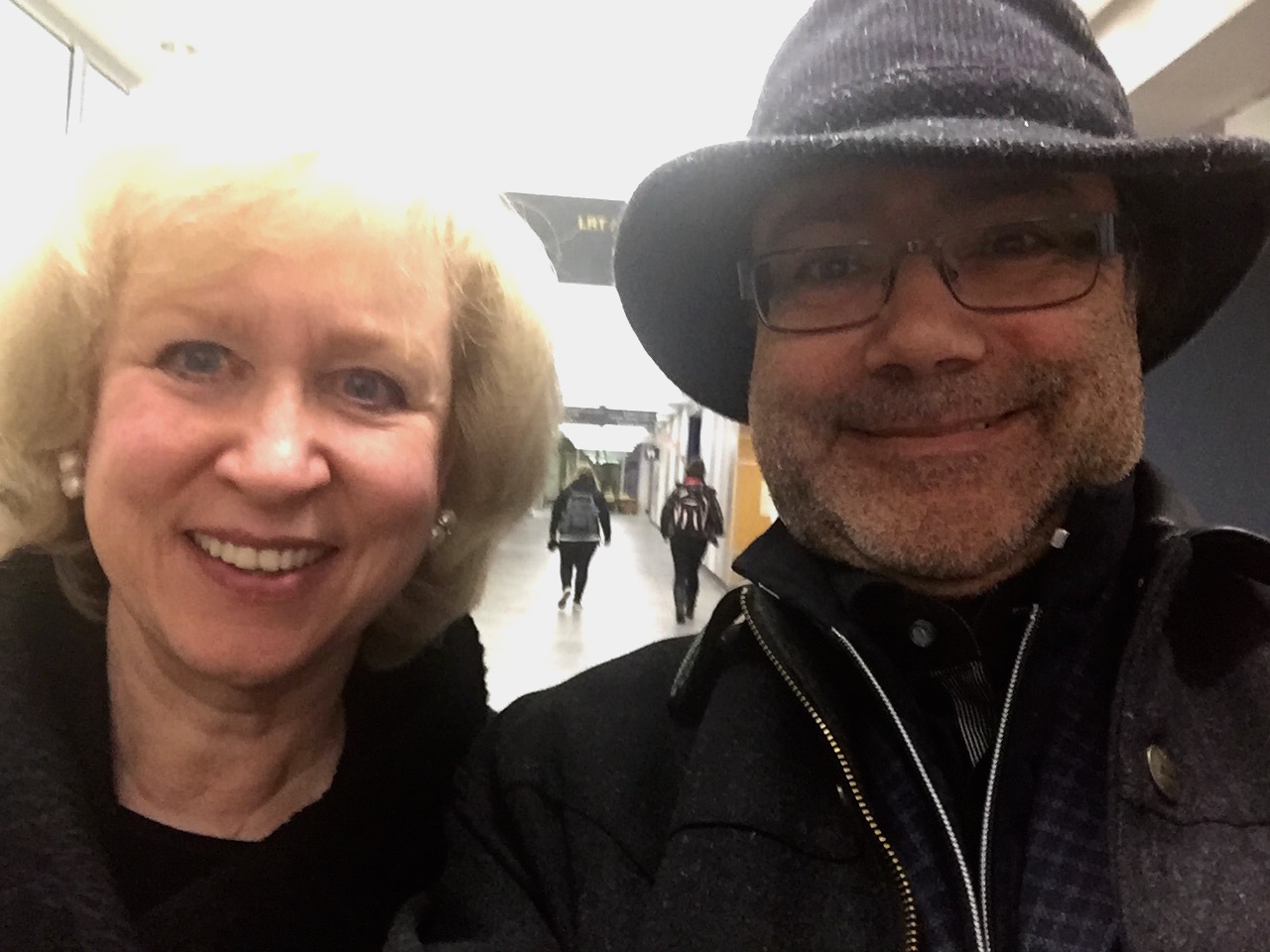
The Right Honourable Kim Campbell, PC, CC, OBC, QC, with Arya M. Sharma, MD, FRCPC
Earlier this week, I spoke at a leadership lecture series on barriers to participation at the Peter Lougheed Leadership College at the University of Alberta.
The speaker series was hosted by the principal of the college,the Right Honourable Kim Campbell, who served as Canada’s 19th prime minister in 1993.
While I spoke about the particular challenges and barriers faced by Canadians living with obesity and how these can be accommodated and supported in the workplace and society in general, other speakers spoke on the accommodation of individuals living with other challenges.
Thus, Kelly Falardeau, herself a victim and advocate for burn survivors and Deryk Beal, one of Canada’s leading clinician scientists on stuttering and other speech impediments, joined me in speaking on the importance of diversity and the need to identify obstacles to social inclusion that keep individuals from reaching their full potential.
In my presentation I did my best to portray the biological, physical, emotional and societal challenges that Canadians living with obesity face everyday.
Here is what I asked the students to think about:
“So how can we help people living with such barriers?
For one, let us educate ourselves on the real issues – if there was an easy solution that actually worked, believe me my clinic would be empty.
Secondly, let us show some respect for people who wake up with this barrier every single morning and go through their day – for the most part doing everything everyone else does.
Thirdly, let us acknowledge that once you have obesity there is no easy way back. I have patients who have lost their entire weight over on diet after diet after diet only to put the weight back again. Diet and exercise is simply not enough for most people – surgery works but is not available and not scalable – we cannot do surgery on 120,000 Albertans. So let us not pretend that there is an easy solution to the problem – we simply don’t have enough treatments that work.
Fourthly, till we do come up with more treatments that actually work or maybe even get our act together on prevention, let us not make life harder for people living with this barrier than it has to be. We can do many things to accommodate people living with obesity – we accommodate people with all kinds of “special needs” at home, in society in the workplace – just not for people living with obesity.
Fifth, let us show our support for people who struggle with their weight by the way we treat them, the way we talk about them, the way we engage with them – they are people like all of us. Just because they carry extra weight does not mean they are second class citizens or people we can simply make fun of or ignore – we are after all talking about 7 million Canadians – men, women and children.
Let us not be the barrier that makes their life even more difficult than it already is.”
Our presentations were followed by an enthusiastic ‘master class’ with students in the inaugural leadership class of the Peter Lougheed Leadership College.
I’d like to thank the organizers for giving me the opportunity to advocate on behalf of Canadians living with obesity.
@DrSharma
Edmonton, AB
Watch Dr. Sharma in the News!
Listen to Dr. Sharma!